

Here's a question I hear constantly from parents: are scholarships hard to get?
The honest answer is both yes and no. National competitions with massive prize amounts? Those are genuinely difficult. The Coca-Cola Scholars Program receives over 90,000 applications for just 150 awards. Your student's odds there are roughly 0.17%.
But here's what most families don't realize: billions of dollars in scholarship funding go unclaimed every year. According to the National Scholarship Providers Association, students left over $100 million on the table last year alone. Why? Because they either didn't know how to find opportunities, assumed they were too competitive, or simply gave up too soon.
I've worked with over 2,500 students, and I've helped them secure more than $25 million in scholarship funding over the past 13 years. What I've learned is this: success becomes dramatically easier when you know where to focus your energy.
The key is understanding that not all opportunities are created equal. Some require exceptional academic credentials, lengthy applications, and compete against tens of thousands of students. Others require only a simple essay, have just a few dozen applicants, and actively want to give money to students in your community.
Why Finding Funding Feels Harder Than It Actually Is
When parents ask me this question, I usually ask them back: what kind of opportunities are you looking at? Because that's the real issue. Most families start their search in the wrong place, which makes the entire process feel impossibly difficult.
Let me paint a common scenario. Your student downloads a search app, creates a profile, and suddenly gets matched with 200 opportunities. Sounds great, right? Except most of those "opportunities" are promotional sweepstakes where your student enters their name and email address to win $1,000, competing against 500,000 other students.
Those aren't real awards. They're marketing tools designed to collect student data. And yes, those are genuinely difficult to win because they're essentially lotteries with terrible odds.
The opportunities that are genuinely worth your student's time fall into different categories, and understanding these categories changes everything about whether the process feels difficult or remarkably achievable.
The Local vs. National Divide
This is the single most important concept I teach families. Local awards are exponentially easier to win than national competitions. I've seen students win $2,000 from their local Rotary Club with a straightforward application that took three hours to complete. Meanwhile, they spent fifteen hours on a national application and didn't even make the semifinalist round.
Why are local opportunities easier? The applicant pool is dramatically smaller. Instead of competing against 50,000 students nationwide, your student might be competing against 30 students from your county. The selection criteria are often less stringent. And in many cases, the selection committee knows families in the community personally, which means demonstrated character and local involvement carry significant weight.
When you're applying locally, competition is limited and requirements are manageable. But you do need to know where to look, which brings me to the most reliable starting point.

Where to Find Scholarships That Match Your Student's Profile
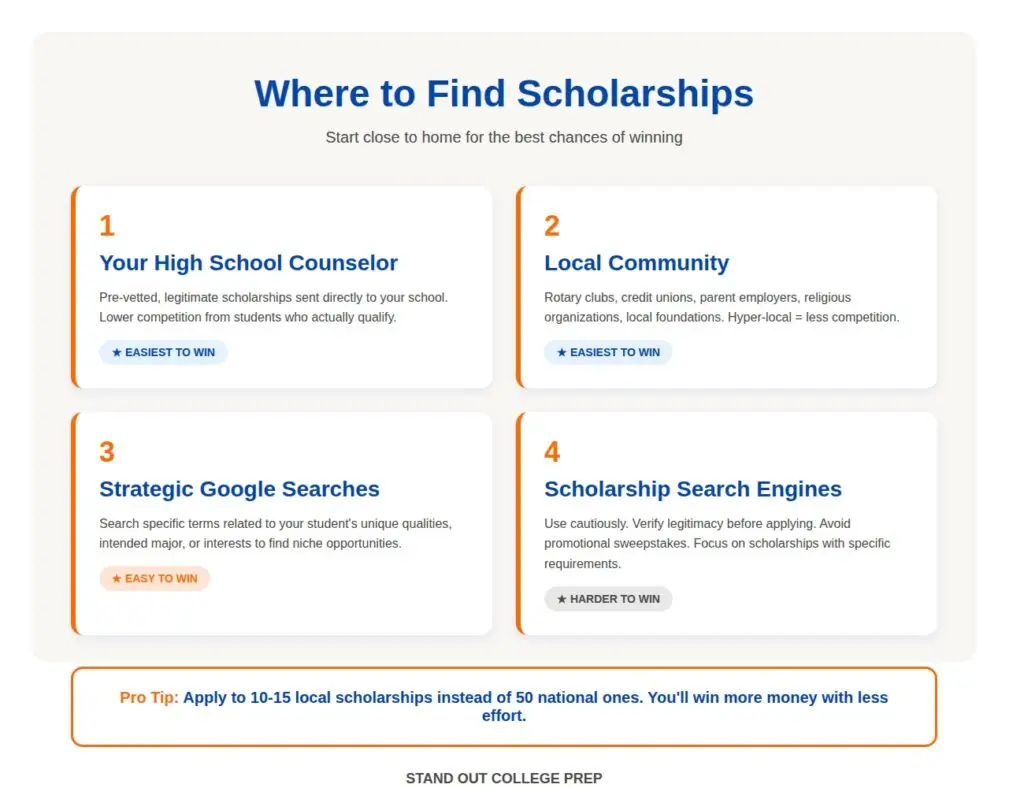
If I could give you just one piece of advice about finding scholarships, it would be this: start close to home and work outward. The farther away from your community you search, the more competitive opportunities become. Let me walk you through the four most productive places to focus your scholarship search.
Your High School Counseling Office
Your high school counselor receives dozens of scholarship announcements throughout the year. These come from local organizations, community foundations, alumni groups, and regional scholarship programs. Many counselors post these opportunities on Naviance, share them in newsletters, or maintain a bulletin board in the counseling office.
Here's why starting with your counselor makes sense: these opportunities are pre-vetted. Your counselor has likely worked with these scholarship organizations for years. They know which ones are legitimate, which ones actually award money, and which ones are appropriate for students at your school. You're not wasting time on scams or promotional sweepstakes.
I recommend your student send their counselor an email that says something like: "I'm actively searching for scholarship opportunities. Could you point me toward any scholarships you've shared recently or let me know where you post scholarship announcements?" This simple email can unlock a list of viable opportunities within 24 hours.
One important note: don't assume your counselor will automatically think of your student when scholarships cross their desk. Counselors work with hundreds of students. Making your interest known ensures your student stays on their radar when relevant opportunities arise.
Community Organizations and Local Connections
This is where scholarships stop feeling impossible and start becoming genuinely accessible. Local organizations want to support students in their community. They're not looking for perfect 4.0 GPAs or national-level achievements. They're looking for students who demonstrate character, involvement, and connection to their cause or community.
I tell families to create a comprehensive list of every organization they're connected to, even tangentially. This includes:
- Credit unions and local banks where you have accounts
- Parent and grandparent employers
- Service organizations like Rotary Club, Lions Club, Kiwanis, Elks Lodge
- Religious organizations and faith communities
- Community foundations specific to your city or county
- Local chambers of commerce
- Professional associations related to parent careers
- Alumni associations from colleges parents attended
- Hobby or interest groups (garden clubs, genealogy societies, etc.)
Then simply reach out and ask: "Does your organization offer scholarships for high school seniors?" You'd be surprised how many organizations have small scholarship programs that receive very few applications simply because students don't know to ask.
Many local scholarships receive fewer than 20 applications. The competition isn't fierce. The requirements are manageable. And the cumulative impact can be substantial.
Organizations offering these scholarships genuinely want to award the money. They've budgeted for it. They've created the program to support students. They're not trying to make the process difficult. They're trying to make a difference in their community.
Strategic Internet Searching
Now we get to the internet, which is where most families start their scholarship search and where many become discouraged. The internet can be incredibly valuable for finding scholarships, but only if you use it strategically.
First, forget about generic scholarship search engines that promise to match your student with thousands of opportunities. Those databases are filled with promotional scholarships, expired awards, and highly competitive national programs. The signal-to-noise ratio is terrible.
Instead, use Google with specific search terms. Think about what makes your student unique, then search for scholarships related to those qualities. For example:
- "scholarships for left-handed students"
- "scholarships for tall students over 6 feet"
- "scholarships for students who raise chickens"
- "scholarships for debate team members"
- "scholarships for vegetarian students"
Yes, these specific scholarships exist. And yes, they're significantly easier to win than broad "merit scholarships for high achievers" because the applicant pool is self-selecting and smaller.
I also recommend searching for scholarships related to your student's intended major or career field. Professional associations often offer scholarships for students entering their field. These can be more accessible because they're looking for future professionals, not necessarily current academic superstars.
For example, if your student plans to study engineering, search for:
- Society of Women Engineers scholarships
- National Society of Professional Engineers scholarships
- Scholarships from specific engineering disciplines (civil, mechanical, electrical)
According to the American Society of Engineering Education, professional engineering organizations award millions in scholarships annually, with many receiving modest application numbers because students don't know these opportunities exist.
One critical warning: if a scholarship asks you to pay an application fee or requests banking information, it's a scam. Legitimate scholarships never require payment to apply. If something feels off, Google the scholarship name plus the word "scam" before investing time in the application.
Making Scholarships Easier: Application Strategy
Even when you've found the right scholarships, there's still the question of whether your student can actually win them. This is where strategy matters as much as credentials.
Quality Over Quantity
Parents often ask me how many scholarships their student should apply for. My answer surprises them: focus on quality applications for scholarships you're genuinely qualified for rather than submitting dozens of rushed applications.
Even local scholarships with limited competition require strong applications. I've seen students lose winnable opportunities because they rushed the essay, skipped proofreading, or submitted generic responses that could apply to any scholarship.
I recommend your student identify 10 to 15 scholarships where they genuinely meet the qualifications and can submit strong applications. A well-crafted application that speaks directly to the scholarship's mission and criteria will always outperform a generic essay sent to 50 different committees.
The Power of Customization
This might sound obvious, but selection committees can immediately tell when students reuse the same essay for multiple applications. And nothing undermines your chances more than submitting a generic response that doesn't address the specific organization's values or criteria.
I teach students to research each organization before writing. What does this organization care about? What's their mission? What kind of student are they hoping to support? Then craft your essay to align with those values while remaining authentic to who you are.
For example, if you're applying to a community service organization, your essay should emphasize your service work and commitment to helping others. If you're applying to a professional nursing association, your essay should connect your personal experiences to your nursing aspirations.
When you customize your application, you demonstrate that you've taken the time to understand what the organization values and show them why you're a good fit. This significantly improves your odds.
Recommendation Letters That Stand Out
Many local programs require one or two recommendation letters. This is actually an advantage for students who plan ahead, because a strong recommendation letter can differentiate your student from other applicants with similar grades and activities.
Choose recommenders who know your student well and can speak to specific qualities relevant to the opportunity. A detailed, personalized letter from a youth group leader who can describe your student's character and community impact will carry more weight than a generic letter from a teacher who simply confirms your student earned an A in their class.
Give your recommenders plenty of time, at least three weeks before the deadline. Provide them with information about the opportunity, what qualities they're looking for, and specific examples or stories they might include. This makes it easier for them to write a strong letter and shows respect for their time.
The Timeline: When Opportunities Become Available
Understanding when applications open changes whether they feel overwhelming or simply require good planning. Most local and regional programs open applications in the fall and have deadlines between January and March. This aligns with senior year of high school, when students are simultaneously managing college applications.
National competitions often have earlier deadlines, sometimes as early as October or November of senior year. This is one more reason why local options can be more manageable. The timeline works better, and you can focus efforts after completing college applications in December and January.
I recommend students start their search in September of senior year, create a list of targets by October, and then dedicate serious time to applications in January and February when college applications are complete. This prevents burnout and allows students to submit strong applications rather than rushing through them.
Some opportunities for current college students have spring deadlines, often in February or March for awards covering the following academic year. These can be more accessible because many students don't realize they can continue applying throughout college.
Common Mistakes That Reduce Your Chances
I've watched students make the same mistakes year after year, mistakes that make even accessible opportunities feel impossible to win. Let me help you avoid these pitfalls.
Starting Too Late
Students who start looking in March or April of senior year miss most deadlines. By the time they realize opportunities are available, the applications have closed. This makes finding funding feel impossible simply because there aren't many options left.
Start early. Begin researching in the summer before senior year or early fall. Create your list in September and October. This gives your student time to prepare strong applications without the pressure of imminent deadlines.
Ignoring Small Awards
Some parents dismiss $500 or $1,000 awards as not worth the effort. This is a mistake. Small programs often attract fewer applicants. And multiple small awards add up quickly.
I tell families: a $500 award might require three hours of work. That's over $150 per hour. Where else can your student earn that kind of money? Plus, winning several small awards builds momentum and creates a stronger financial aid package overall.
Not Following Instructions
This sounds simple, but you'd be surprised how many students lose opportunities because they didn't follow basic instructions. They submit 600 words when the limit was 500. They miss required documents. They ignore formatting guidelines.
Selection committees will disqualify applications that don't meet basic requirements. Create a checklist for each application and verify you've completed every requirement before submitting.
The Reality: Most Students Can Win College Funding
So, are scholarships hard to get? Here's what I tell parents after 13 years of doing this work: college funding is accessible to most students who approach the process strategically. You don't need a 4.0 GPA. You don't need perfect test scores. You don't need to be student body president or a national champion athlete.
What you need is a realistic understanding of which opportunities match your student's qualifications, a willingness to invest time in quality applications, and the persistence to apply for multiple programs. Students who do this consistently win money. Maybe not the $50,000 national awards, but meaningful amounts that reduce college costs and minimize student loans.
According to the U.S. Department of Education, private funding can cover anywhere from a few hundred dollars to full tuition, depending on how many students apply for and win. The students who succeed are those who start early, focus on appropriate opportunities, and submit thoughtful applications.
I've worked with students across the academic spectrum. Some had stellar credentials. Others were solid B students involved in their communities. Both groups won awards. The difference wasn't their achievements. It was their approach to the process.
Next Steps: Your Action Plan
If you're ready to start finding funding for your student, here's what I recommend:
First, shift your mindset. Stop thinking about awards as rare prizes given only to exceptional students. Start thinking about them as community investments in education that your student can access with the right strategy.
Second, focus your energy on local and regional opportunities. These are genuinely more accessible, and they add up to meaningful money. Save national competitions for later, after you've secured local funding.
Third, treat applications like the important financial documents they are. Invest time in strong essays, secure thoughtful recommendations, and proofread carefully. Quality applications win awards.
Finally, stay organized. Track deadlines, requirements, and submission status for each opportunity. Missing a deadline or forgetting a required document turns an achievable chance into a missed one.
With the right approach, most students can secure funding that makes college more affordable and reduces reliance on student loans. The money is there. You just need a clear plan to find it.
To help you get started, I've created a Scholarship Organizing Starter Pack with templates for tracking deadlines, organizing applications, and crafting strong essays. You'll also find guidance on writing thank-you notes after winning awards and understanding opportunities like Division 3 athletic scholarships that many families overlook.
The process doesn't have to feel overwhelming or impossible. With clarity, organization, and the right strategy, your student can find and win funding that makes college more affordable. That's not just possible when you know where to focus your efforts, it's probable.